






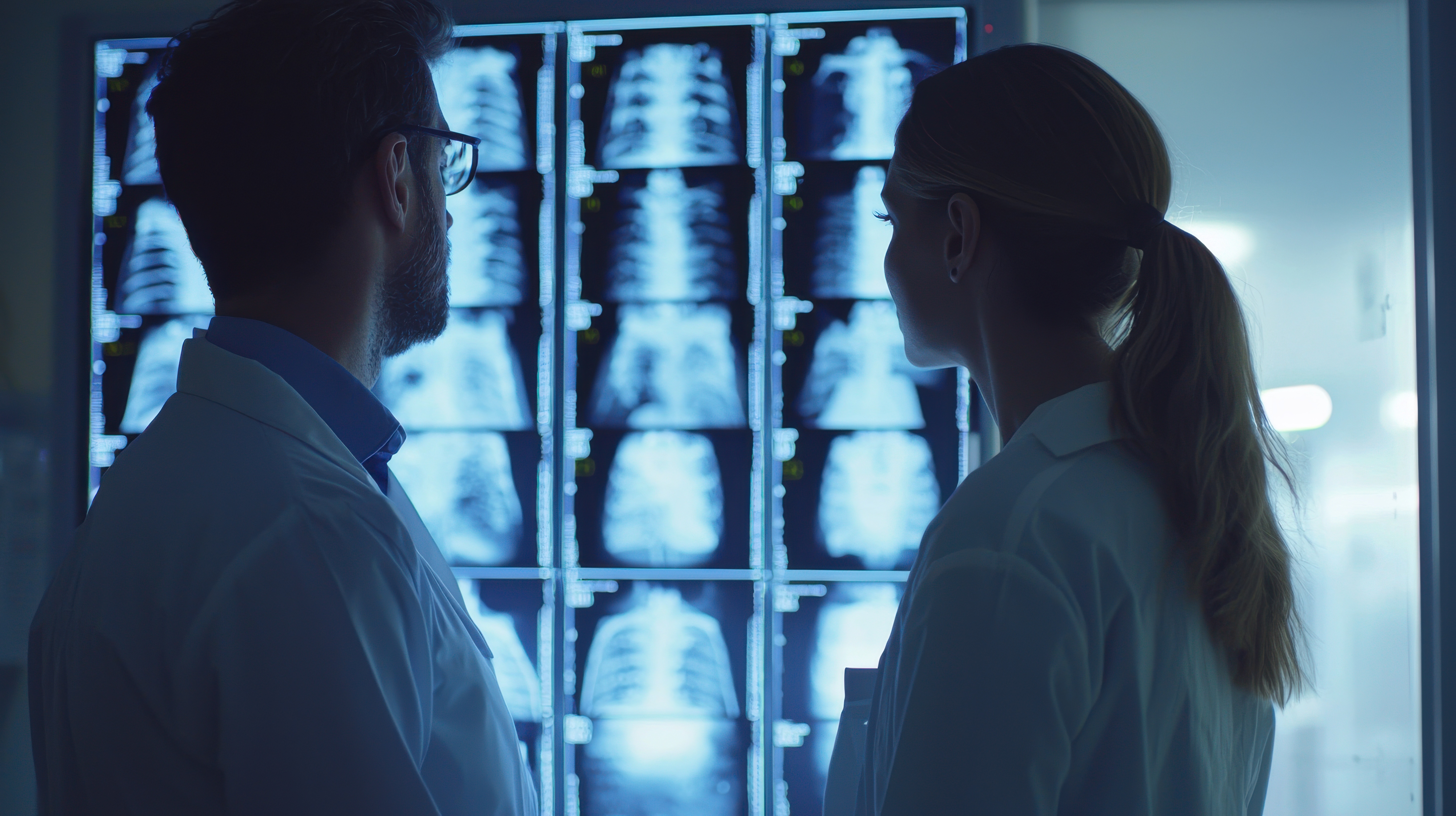
We are announcing novel AI research designed to transform healthcare analytics, medical image analysis, and radiological diagnosis targeting a breadth of diagnostic challenges. GE HealthCare’s X-ray foundation model is built on an expansive dataset of 1.2 million anonymized X-ray images from diverse regions across the full body and powered by the most performant language models available. Through this research, GE HealthCare is exploring how these models can offer real-world practical value to healthcare professionals seeking efficient and reliable tools for diagnostics and data management by performing established tasks like segmentation and classification with improved accuracy.
Most of the healthcare industry’s data is unstructured. Data from medical images, notes, audio recordings, and device readings exist across multiple modalities, which render it unusable by traditional analytics, business insight capabilities, and even most machine learning algorithms. However, traditional AI approaches in the industry, while effective within specific modalities, struggle with these diverse data types ranging from text and images to audio and video. Additionally, traditional approaches require vast amounts of domain-specific data and manual feature engineering for different disease states leading to costly and resource-intensive development cycles. As a result, critical medical insights can be missed, and clinicians are forced to spend valuable time and resources sifting through data manually.
To address these challenges, we are pioneering the development of foundation models in healthcare. These sophisticated AI systems are fine-tuned for healthcare datasets, with the goal of enabling superior performance and adaptability across diverse applications. If fully developed, multimodal medical LLMs could become the foundation for new assistive technologies in professional medicine, medical research, and consumer applications. As with our past initiatives, we emphasize the critical need for a comprehensive evaluation of these technologies in collaboration with the medical community and the broader healthcare ecosystem
In internal testing, our full-body X-ray model stands out even with limited training data or when faced with out-of-domain challenges, showcasing its robustness and generalizability. Remarkably, when we fine-tuned the model using only chest-specific training data, it still showed significant improvements in non-chest-related tasks, such as anatomy detection and lead marker detection, outperforming in our experiments existing chest-specialized pre-trained models.
Our […]
Latest advances in Research: Building a multimodal X-ray foundation model


