




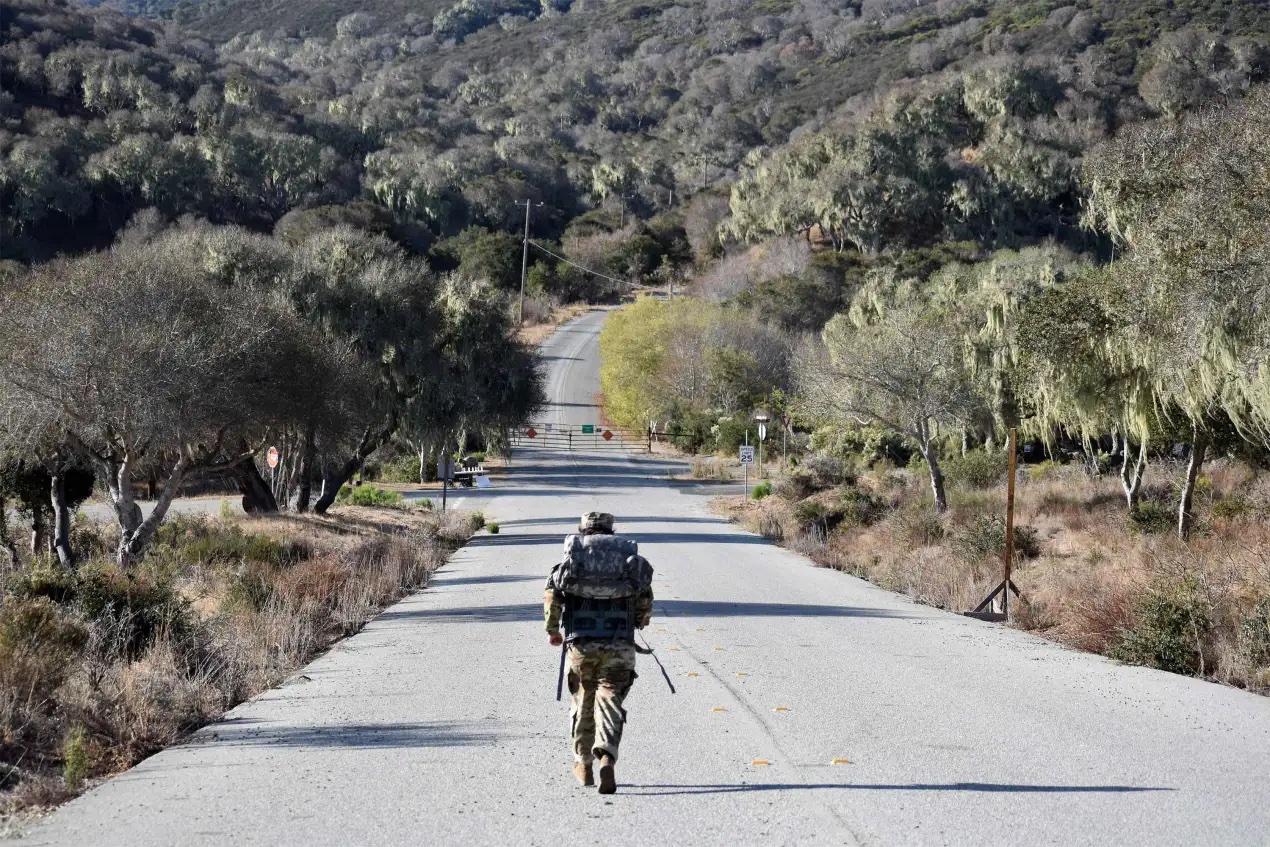
A soldier participates in the Norwegian Foot March at Fort Ord National Monument, in Monterey County, California, Oct. 28, 2022. Mounting evidence shows that to kill pervasive poison oak and other weeds at Fort Ord — a former Army base, which closed in 1994 — the military sprayed and experimented with the powerful herbicide combination Agent Orange as far back as the 1950s. (Photo by Winifred Brown of the U.S. Army)
As a young GI at Fort Ord in Monterey County, California, Dean Osborn spent much of his time in the oceanside woodlands, training on soil and guzzling water from streams and aquifers now known to be contaminated with cancer-causing pollutants.
“They were marching the snot out of us,” he said, recalling his year and a half stationed on the base, from 1979 to 1980. He also remembers, not so fondly, the poison oak pervasive across the 28,000-acre installation that closed in 1994. He went on sick call at least three times because of the overwhelmingly itchy rash.
Mounting evidence shows that as far back as the 1950s, in an effort to kill the ubiquitous poison oak and other weeds at the Army base, the military experimented with and sprayed the powerful herbicide combination known colloquially as Agent Orange.
While the U.S. military used the herbicide to defoliate the dense jungles of Vietnam and adjoining countries, it was contaminating the land and waters of coastal California with the same chemicals, according to documents.
The Defense Department has publicly acknowledged that during the Vietnam War era it stored Agent Orange at the Naval Construction Battalion Center in Gulfport, Mississippi, and the former Kelly Air Force Base in Texas, and tested it at Florida’s Eglin Air Force Base.
According to the Government Accountability Office, however, the Pentagon’s list of sites where herbicides were tested went more than a decade without being updated and lacked specificity. GAO analysts described the list in 2018 as “inaccurate and incomplete.”
Fort Ord was not included. It is among about four dozen bases that the government has excluded but where Pat Elder, an environmental activist, said he has documented the use or storage […]
Exposure to Agent Orange at U.S. bases, some veterans face cancer with VA support


